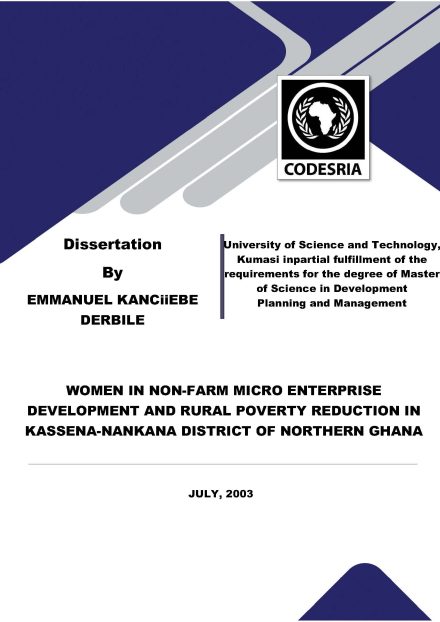
Women in non farm micro enterprise development and rural poverty reduction in Kassena-Nankana district of northern Ghana
2023
Abstract views : 1,091 Downloads : 203

CODESRIA Books Publication System
This study examines the transformation of the agrarian employment in the former large scale
commercial farming sector (LSCF) after the implementation of the Fast Track Land Reform Programme
(FTLRP) by the government of Zimbabwe that redistiibuted over 80 percent of the farms to mostly
landless peasants from the communal areas. The key question posed is whether the transfer of land
from the former large-scale commercial farmers has created or inhibited opportunities for rural
labour to gain incomes and/or livelihoods through self employment as own agricultural producers or
in paid wage work. The study was based on a questionnaire survey administered in newly resettled
households in Zvimba District and secondary data sources. Vaiious statistical tools were utilised
to answer the study's research questions. Firstly, descriptive statistics were used to characterise
the forms of labour that have emerged in the newly resettled areas. Secondly, the Analysis of
Variance (ANOVA) test was used to examine the differences in the labour utilisation across the
different farm sizes allocated under the FTLRP. Lastly the Chi-Square test was used to relate
different factors which were thought to affect the utilisation of labour in newly resettled areas.
The study found that FTLRP bas been accompanied by the degree of self employment as own producers
among newly resettled households in the former wage labour market, although some hired in labour.
Hired labour was dominated by casual workers. In comparison to the past scenaiio the size of the
agricultural employment had increased, but new and former farm workers earned unviable wages and
benefits and were thus less protected than those in other LSCF subsectors. There was also
underutilisation and Joss of skills of former farm workers employed in the former LSCF sector.
Larger farms with access to capital equipment such as tractors tended to use more absolute hired
labour and permanent workers per unit of cropped area, whilst the smaller farms utilised more
family and casual labour per unit of cropped area. Across the small and large farms in newly
resettled areas, labour use per unit of cropped area was higher compared to the former LSCF sector.
In conclusion the land reform programme has the potential to generate employment and thus solve the
growing unemployment problem in Zimbabwe, but the capacity of new farmers bas to be enhanced to
fully utilise their land which is still below its potential through the resolution of production
constraints that include finance, skills, input shortages and extension
services.
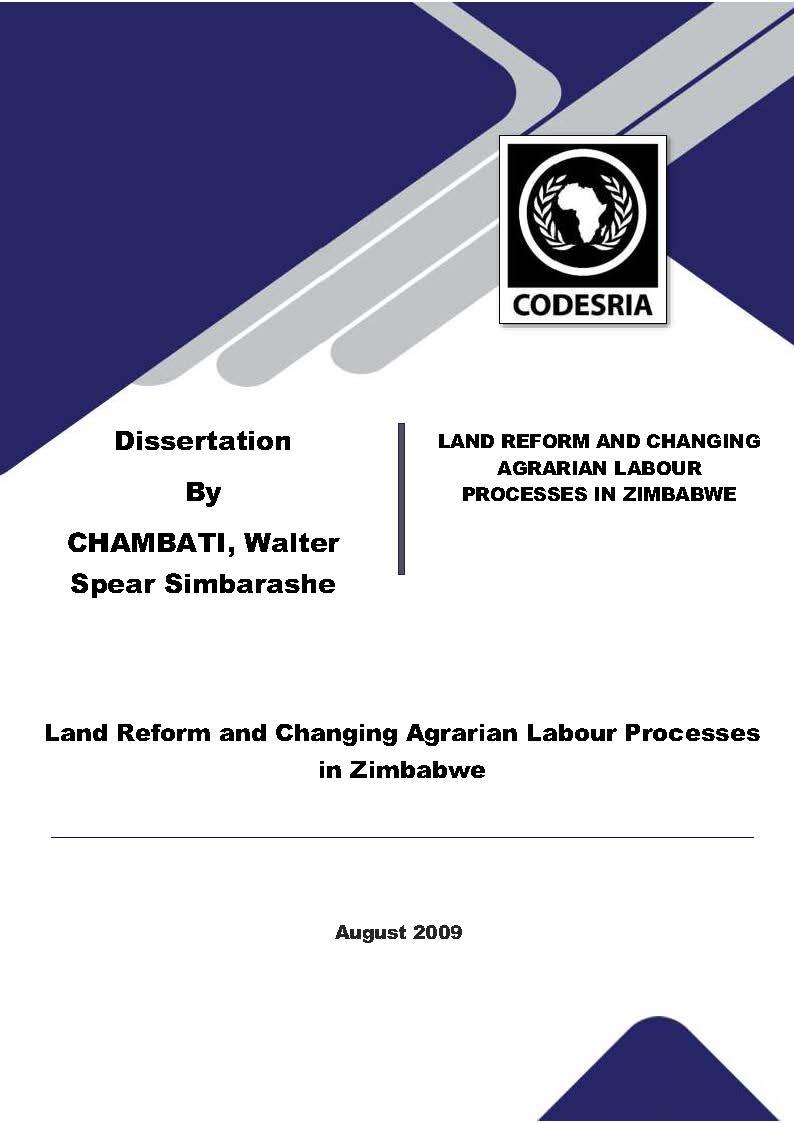
APA Simbarashe, C. W. S. (2023). Land Reform and Changing Agrarian Labour Processes in Zimbabwe August. CODESRIA. https://doi.org/10.57054/codesria.pub.1627
Chicago Simbarashe, CHAMBATI, Walter Spear. Land Reform and Changing Agrarian Labour Processes in Zimbabwe August. Dakar: CODESRIA, 2023. https://doi.org/10.57054/codesria.pub.1627.
MLA Simbarashe, CHAMBATI, Walter Spear. Land Reform and Changing Agrarian Labour Processes in Zimbabwe August. CODESRIA, 2023. https://doi.org/10.57054/codesria.pub.1627.
2023
Abstract views : 1,091 Downloads : 203
2023
Abstract views : 919 Downloads : 318
2023
Abstract views : 977 Downloads : 265
2023
Abstract views : 1,128 Downloads : 196
2023
Abstract views : 992 Downloads : 215
2023
Abstract views : 1,224 Downloads : 159
2023
Abstract views : 1,129 Downloads : 248
2023
Abstract views : 1,188 Downloads : 195
2023
Abstract views : 936 Downloads : 227
2023
Abstract views : 870
2023
Abstract views : 1,113 Downloads : 118
2023
Abstract views : 991 Downloads : 164