Impacts de l’efficacité Technique sur la Productivité des Exploitations Cotonnières au Burkina Faso
2023
Abstract views : 1,495 Downloads : 241

CODESRIA Books Publication System
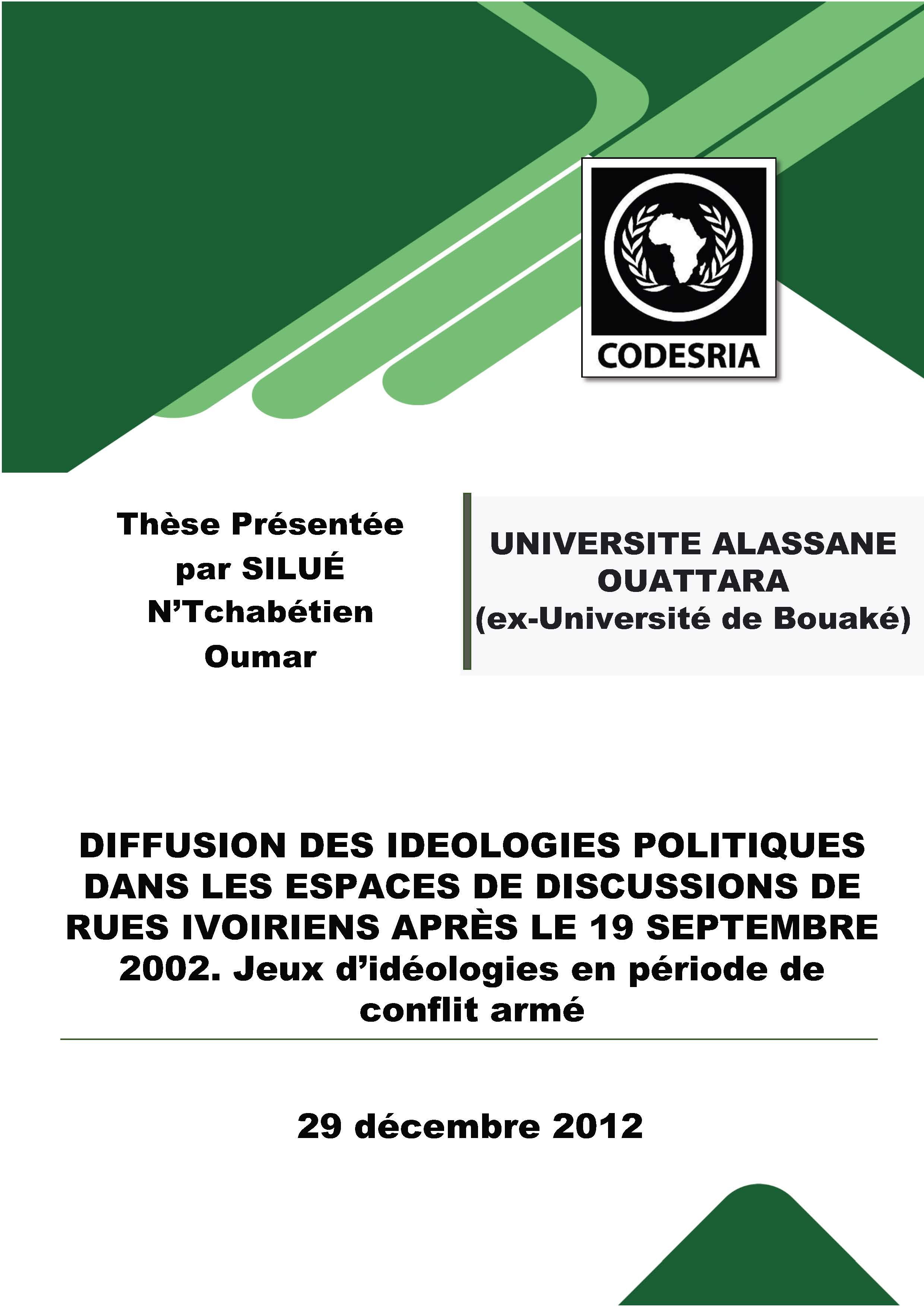
This study focuses on the strategies streets discussion spaces use for disseminating political ideologies into the Ivorian social mainstream, within the context of the armed conflict which broke out in the West African country on September 2002. The study supports the following idea: street discussion spaces have been instrumental in propagating political ideologies during the conflict (September 2002) in Ivory Coast. It is based on ethnographic methods. Participant observation and interviews have also been used in the framework of the research methodology in order to gather materials and verify the three leading hypothesis of the work.
The first part presents Street Discussion Spaces (SDS) from a diachronic perspective. SDS are spaces where people meet to discuss the latest news. These spaces fall into two categories: the “Agoras” and the “Parlement” which are pro-FPI (Ivorian Popular Front – the former ruling party) and the “Grins”, very supportive of the RDR (Rally of Republicans) and its allies. The second part brings to the fore the links between the SDS and political parties. SDS are no longer open democratic spaces that they used to be; since the military transition in 1999, SDS witnessed a slow slide into politics. The political belonging of SDS’ speakers has turned SDS into political arenas. SDS leaders’ struggle for the conquest of spaces, their space preservation strategies and their open support to politicians reveal their political identity. Eventually, SDS leaders use three strategies to help diffuse political ideologies. They comment political discourse in a way to spark off reactions and emotions within the audience.
The opening of the SDS to politicians contributed to the diffusion of political discourse. In addition, SDS leaders’ mobility from one space to another and their rewriting and exploration of the nation’s history (reference to monuments, the praise of national heroes, chants, etc), added to the use of Information Technology devices also contribute to disseminate and promote political ideologies. The SDS usually draw political debates from the political field and use it for their own purposes. The "Agora" and "Parlement" back the former ruling party, the Ivorian Popular Front (FPI), while the "Grins" are supportive of the opposition parties, namely the Rally of Republicans (RDR). SDS’ incursion into politics vividly testifies to youth’s ambition to be
part of the Ivorian political game.
APA Oumar, S. N. (2023). An Empirical Investigation of Technical Change in Tanzania Manufacturing Industry Dar es Salaam. CODESRIA. https://doi.org/10.57054/codesria.pub.1535
Chicago Oumar, SILUÉ N’Tchabétien. An Empirical Investigation of Technical Change in Tanzania Manufacturing Industry Dar es Salaam. Dakar: CODESRIA, 2023. https://doi.org/10.57054/codesria.pub.1535.
MLA Oumar, SILUÉ N’Tchabétien. An Empirical Investigation of Technical Change in Tanzania Manufacturing Industry Dar es Salaam. CODESRIA, 2023. https://doi.org/10.57054/codesria.pub.1535.
2023
Abstract views : 1,495 Downloads : 241
2023
Abstract views : 1,509 Downloads : 222
2023
Abstract views : 993 Downloads : 179
2023
Abstract views : 981 Downloads : 184
2023
Abstract views : 990 Downloads : 163
2023
Abstract views : 1,128 Downloads : 163
2023
Abstract views : 787 Downloads : 422
2023
Abstract views : 1,718 Downloads : 253
2023
Abstract views : 704 Downloads : 119
2023
Abstract views : 784
2023
Abstract views : 1,243 Downloads : 189