Acceptabilité du condom féminin chez les personnes sexuellement actives à Yaoundé
2023
##plugins.themes.clarte.stats.views## : 1 224 ##plugins.themes.clarte.stats.downloads## : 159

CODESRIA Books Publication System
Rural poverty is a complex, interlocked and multi-dimensional phenomenon. Different scholars attach different meanings to poverty. This implies that if poverty reduction strategies to be effective, sympathetic of the specific characteristics ofindividual groups are required.
In view of this, this study was carried out at Bereh-Aleltu district with the specific objectives of examining the extent of poverty and its detenninants at household level. ln order to attain this aim semi-structured questionnaire was prepared and the survey was undertaken in the three PAs of the district. This questionnaire includes family composition and their characteristics; land
use system,· crop-livestock.enterprises; major agricultural constraints; consumption; expenditure; incarne, public infrastructure and copying mechanisms. To collect the data, two-stage random sampling techniques were employed. In the first stage, three PAs were randomly selected. Then proportionally individuals were randomly selected /rom the respective PAs.
For analytical purpose poverty index, descriptive statistics, logit regression model and marginal effect analysis were applied. Accordingly, by using expenditure per adult equivalent approach, the results of the studies reveal that 80% of the sampled populations were immersed in poverty. As well, the poverty gap and severity index were found to be 31% and 12% respectively. Whereas in Food Energy Inta Approach, those indexes are deflated to 70.8%, 25.4% and 9.11% in the order mentioned.
Many socio-economics opportunities and constraints were explained with the help of descriptive statistics; and Logit mode[ was used to estimate the probability of being poor having dummy dependant for those household below poverty line valued 1; 0 othenvise. All 11 hypothesized explanatory variables, interestingly, the direction of their association were as expected. The results of logistic regression shows that, the most six significant variables were: productivity of land associated negatively with the probability of being poor (at less than 1% of significance level), tropical livestock unit per AE associated negatively with the probability of being poor (at less than 5% of significance level), total family size in adult equivalent associated positively with the probability of being poor (at less than 10% of significance Level), non farm income per houselwld associated negatively with the
probability of being poor (at less than 10% of significance level), dummy of education to complete at least primary school associated negatively with the probability of being poor (at less than 10% of significance level), and number ofyears modem agricultural inputs were used associated negatively with the probability of being poor (at less than 10% of significance level).
Shockingly, the probability of falling in to poverty was found to be 0.998. Nevertheless, when we observe the marginal effects of significant explanatory variables, above ail, promotion of education, say from illiteracy to primary level, reduces poverty by half. Alike, increasing of TLU/AE has likelihood to reduce poverty by 7.418%. In like manner, increasing productivity of land, the use of modem agricultural inputs, and non farm incarne opportunity have a negative marginal effect on poverty by 4.523%, 1.3% and 0.032% respectively.
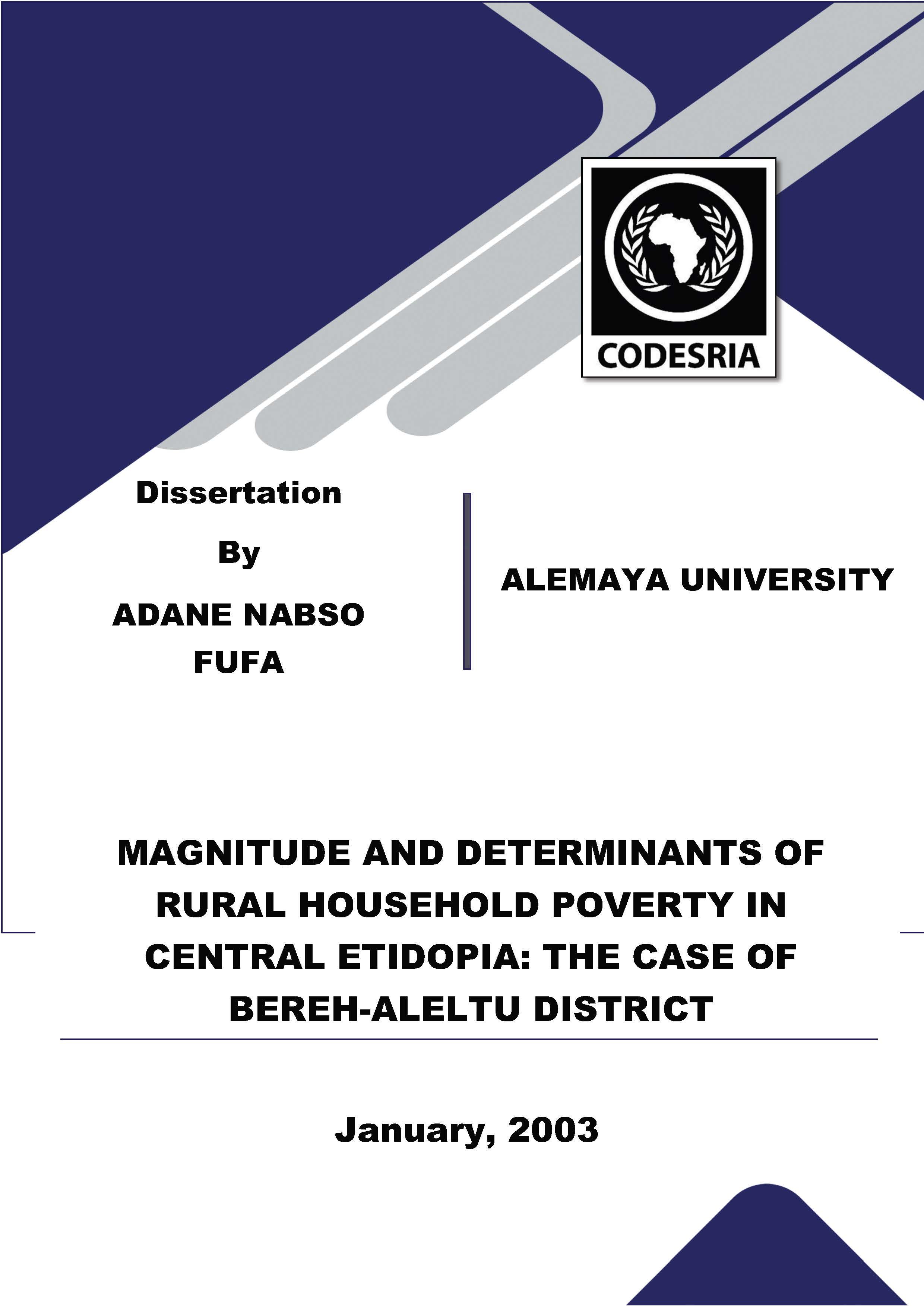
APA FUFA, A. N. (2023). MAGNITUDE AND DETERMINANTS OF RURAL HOUSEHOLD POVERTY IN CENTRAL ETIDOPIA: THE CASE OF BEREH-ALELTU DISTRICT. CODESRIA. https://doi.org/10.57054/codesria.pub.1977
Chicago FUFA, ADANE NABSO. MAGNITUDE AND DETERMINANTS OF RURAL HOUSEHOLD POVERTY IN CENTRAL ETIDOPIA: THE CASE OF BEREH-ALELTU DISTRICT. Dakar: CODESRIA, 2023. https://doi.org/10.57054/codesria.pub.1977.
MLA FUFA, ADANE NABSO. MAGNITUDE AND DETERMINANTS OF RURAL HOUSEHOLD POVERTY IN CENTRAL ETIDOPIA: THE CASE OF BEREH-ALELTU DISTRICT. CODESRIA, 2023. https://doi.org/10.57054/codesria.pub.1977.
2023
##plugins.themes.clarte.stats.views## : 1 224 ##plugins.themes.clarte.stats.downloads## : 159
2023
##plugins.themes.clarte.stats.views## : 1 129 ##plugins.themes.clarte.stats.downloads## : 248
2023
##plugins.themes.clarte.stats.views## : 1 188 ##plugins.themes.clarte.stats.downloads## : 195
2023
##plugins.themes.clarte.stats.views## : 936 ##plugins.themes.clarte.stats.downloads## : 227
2023
##plugins.themes.clarte.stats.views## : 1 091 ##plugins.themes.clarte.stats.downloads## : 203
2023
##plugins.themes.clarte.stats.views## : 919 ##plugins.themes.clarte.stats.downloads## : 318
2023
##plugins.themes.clarte.stats.views## : 977 ##plugins.themes.clarte.stats.downloads## : 265
2023
##plugins.themes.clarte.stats.views## : 1 128 ##plugins.themes.clarte.stats.downloads## : 196
2023
##plugins.themes.clarte.stats.views## : 992 ##plugins.themes.clarte.stats.downloads## : 215
2023
##plugins.themes.clarte.stats.views## : 1 113 ##plugins.themes.clarte.stats.downloads## : 118
2023
##plugins.themes.clarte.stats.views## : 991 ##plugins.themes.clarte.stats.downloads## : 164
2023
##plugins.themes.clarte.stats.views## : 870