Impacts de l’efficacité Technique sur la Productivité des Exploitations Cotonnières au Burkina Faso
2023
##plugins.themes.clarte.stats.views## : 1 495 ##plugins.themes.clarte.stats.downloads## : 241

CODESRIA Books Publication System
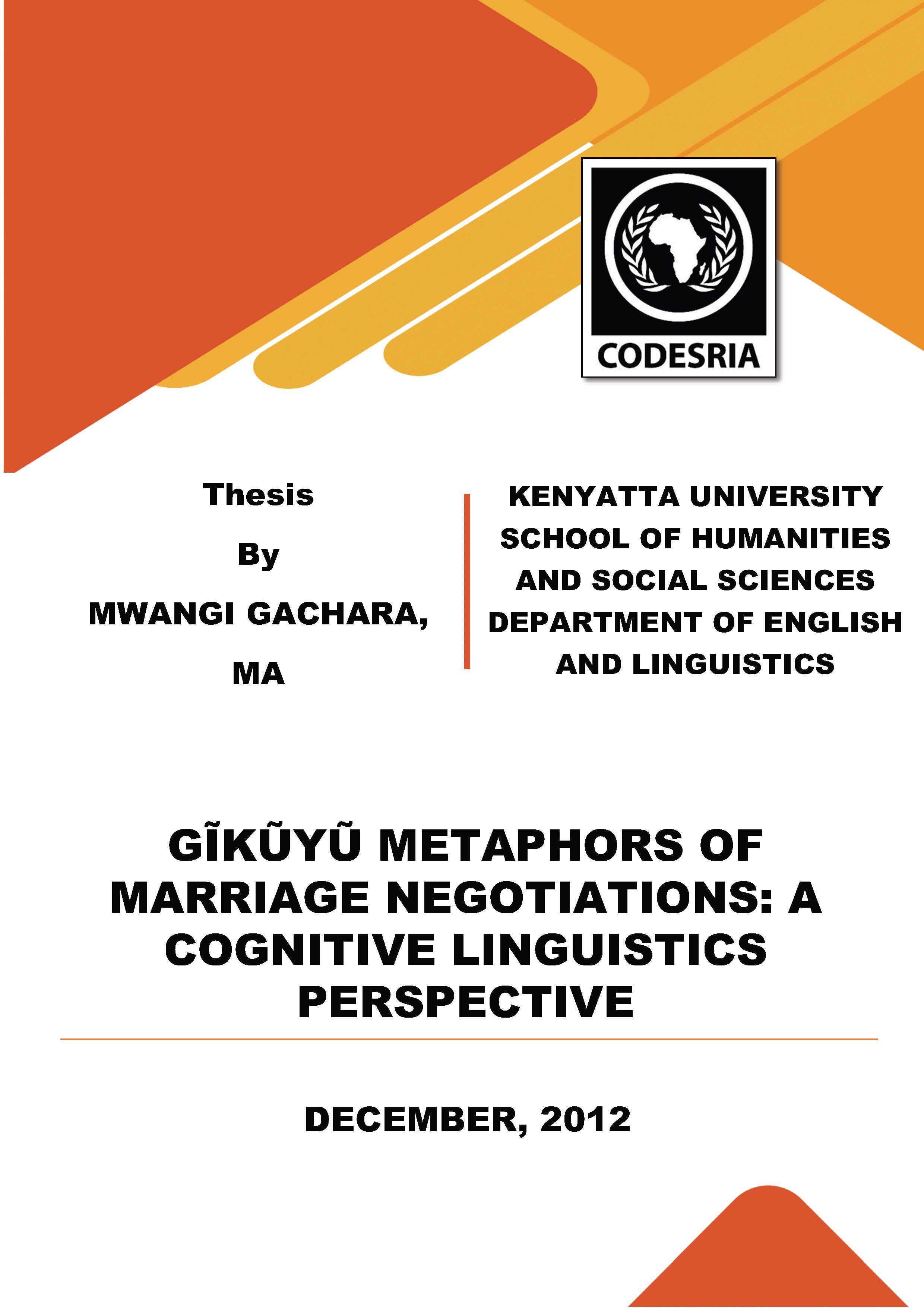
This study identifies, describes, and analyses the metaphors used in the Gĩkũyũ marriage negotiations from a cognitive linguistics perspective.
We audio-recorded discourse from two marriage negotiation gatherings followed by transcription of data and then identification of metaphorically used items. This meant that we subjected all the lexical items collected to the MIPVU to find out which were metaphorical in nature. These metaphors were then analysed in terms of their linguistic form and conceptual structure. The linguistic form looked at which ones were incomplete, rhetorical, shortened or even lengthened, classic, distended or extended.
The conceptual structure looked at whether the metaphorical item is novel (new), conventional (old) or even borderline. This was determined by the respondents‘ interpretation, researcher‘s intuition vs. the research assistant‘s yardstick. The respondents are varied in the social variables of age, sex, and educational level. Lastly, we wanted to find out the extent to which these metaphors can be accounted for within the Career of Metaphor Theory. For each of the three social variables under investigation, we had three respondents, meaning that our population sample had a total 24 respondents.
From the metaphors we collected from the context of marriage negotiations we sampled 20 metaphorical items from each negotiation. It is these 40 metaphorical items that we presented to the twenty four (24) respondents to collect further data
through a questionnaire that sought their interpretation and their level of familiarity with the given metaphors.
In the analysis of the metaphors so collected, we also investigated which ones were understood as comparisons and which ones were understood as categorisations so as to account for the evolution of metaphors, for this is a key tenet in the Career of
Metaphor Theory, our objective number four. The Career of Metaphor Theory helped us in identifying the base and target domains for conventional metaphors and the topic, superordinate and subordinate vehicle concepts for novel metaphors. We then determined the extent to which the theory accounts for Gĩkũyũ metaphors of marriage.
Using the chi square test, the variance in linguistic form, conceptual structure and metaphor interpretation using the variables of age, sex, and level of education were analysed.
We found that metaphors used in marriage negotiations largely treat women as objects and organisms which commodify women. Men on the other hand are treated like weapons of war in turn informing the concept SEX IS WAR. We also found that love is rarely talked about.
We recommend the replacement of negative metaphors with positive one that draw from the PATH and FAMILY domains to give both women and men an equal footing. This thesis is divided into five chapters. Chapter one covers the introduction; chapter two, literature review and theoretical framework; chapter three, research methodology; chapter four, data analysis and data presentation; and chapter five has findings, recommendations and conclusion.
APA MA, M. G. (2023). GĨKŨYŨ METAPHORS OF MARRIAGE NEGOTIATIONS: A COGNITIVE LINGUISTICS PERSPECTIVE. CODESRIA. https://doi.org/10.57054/codesria.pub.1073
Chicago MA, MWANGI GACHARA,. GĨKŨYŨ METAPHORS OF MARRIAGE NEGOTIATIONS: A COGNITIVE LINGUISTICS PERSPECTIVE. Dakar: CODESRIA, 2023. https://doi.org/10.57054/codesria.pub.1073.
MLA MA, MWANGI GACHARA,. GĨKŨYŨ METAPHORS OF MARRIAGE NEGOTIATIONS: A COGNITIVE LINGUISTICS PERSPECTIVE. CODESRIA, 2023. https://doi.org/10.57054/codesria.pub.1073.
2023
##plugins.themes.clarte.stats.views## : 1 495 ##plugins.themes.clarte.stats.downloads## : 241
2023
##plugins.themes.clarte.stats.views## : 1 509 ##plugins.themes.clarte.stats.downloads## : 222
2023
##plugins.themes.clarte.stats.views## : 993 ##plugins.themes.clarte.stats.downloads## : 179
2023
##plugins.themes.clarte.stats.views## : 1 380
2023
##plugins.themes.clarte.stats.views## : 981 ##plugins.themes.clarte.stats.downloads## : 184
2023
##plugins.themes.clarte.stats.views## : 990 ##plugins.themes.clarte.stats.downloads## : 163
2023
##plugins.themes.clarte.stats.views## : 1 128 ##plugins.themes.clarte.stats.downloads## : 163
2023
##plugins.themes.clarte.stats.views## : 1 243 ##plugins.themes.clarte.stats.downloads## : 189
2023
##plugins.themes.clarte.stats.views## : 787 ##plugins.themes.clarte.stats.downloads## : 422
2023
##plugins.themes.clarte.stats.views## : 1 718 ##plugins.themes.clarte.stats.downloads## : 253
2023
##plugins.themes.clarte.stats.views## : 704 ##plugins.themes.clarte.stats.downloads## : 119
2023
##plugins.themes.clarte.stats.views## : 784