Impacts de l’efficacité Technique sur la Productivité des Exploitations Cotonnières au Burkina Faso
2023
##plugins.themes.clarte.stats.views## : 1 495 ##plugins.themes.clarte.stats.downloads## : 241

CODESRIA Books Publication System
For bath policy and pedagogical purposes, a need for an improved appreciation of the dynamics of the mixed economy is evident. This became so especially because of the rapidly unfolding changes taking place in divergent economies of the world, particularly Africa, with the ascendancy of free market theology.
The historically defined status of a Third World economy like Nigeria, within the international division of labour calls for a
qualification of its characterisation as a mixed economy. This also gives added importance to the correct appreciation of the role of the public sector in national development. This is because the State is a juridical arbiter, bath between domestic and international markets, and between socio-economic forces within the national economy, in the process of capital accumulation. The State exerts major influence on patterns of resource allocation; it constitutes a veritable source of pri vate primitive accumulation. Thus, the State is enmeshed in the contradictiohs of accumulation.
Orthodox schools of economic thought conceptualise public sector activities essentially subjectively~ preoccupying themselves with an elusive optimum size of the public sector, wi thin a fundamentally technicist frame of analysis. Classical, neoclassical, public choice and Keynesian schools - all end up wi th recommenda tians of ei ther more, or less, public sector, and corresponding less or more emphasis on private initiative. In par'ticular, the neoclassical paradigm ascribes incorrectly a neutral status to the State. The critical question of what actually determines the size, composition and direction of public expenditure, on a dynamic basis, receives scant attention within the orthodoxy.
The study undertakes a theoretical and empirical exploration of the logît of the dynamics of interaction between the public and
private sectors of the Nigerian economy. The basic Marxian twodepartmental model of capital accumulation is utilised to examine the role of the public sector in facilitating private accumulation in bath the agricul tural and indus trial sec tors. The classical Marxian model of capital/consumer goods format is, however, revised to follow a public/private sector divide, in consonance with tl'ie project concern. Thus, we have two departments, I and II, corresponding to public sector and priva te sector, respectively. Marxian accounting categories are employed to capture inter-sectoral transfer of the various components of surplus value for actual and potential accumulation at their respective destinations.
The study shows that over time the public sector of the Nigerian economy has shifted from a vacillating alliance with the
local branch of private capital to a more open identification with and subservience to, foreign capital as reflected in the industrial policies of the government. Thus public expenditures on programmes of assistance to the private sector for both agricultural and industrial projects inevitably benefit mainly foreign interests.
In particular the huge public expenditures on agriculture are not justified by proportionate increases in agricultural output because significant proportions of such expenditures leak out of the local economy to enlarge foreign monopoly capital.
The policy implication of the unfolding trends in the public private sector relationship is the challenge of bringing the public
sector properly back under the control of the citizenry, in particular, the productive segments so as to ameliorate the festering alienation which undermines the legitimacy of the Nigerian State and hence its capacity to facilitate capital accumulation in
an atmosphere of social harmony.
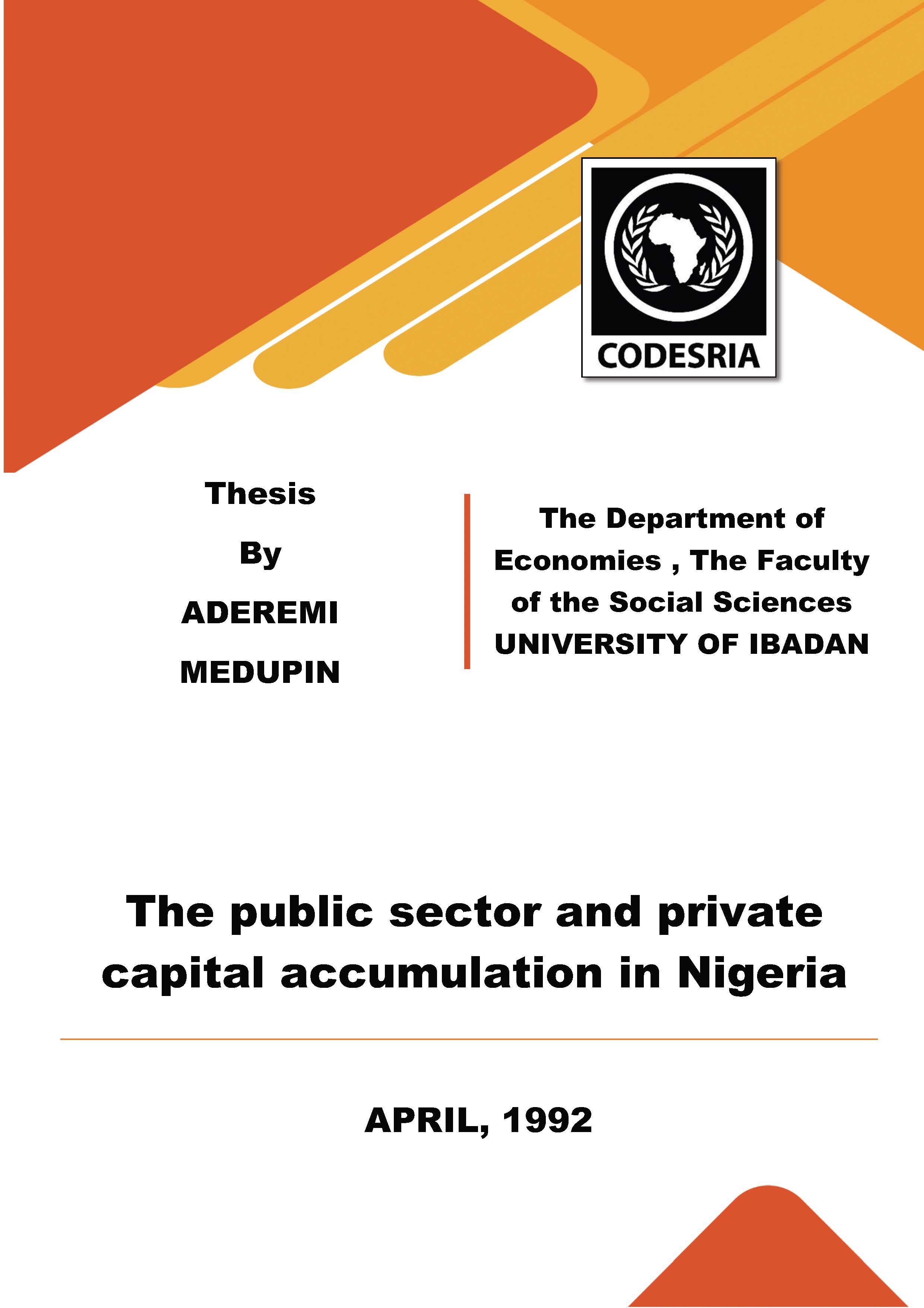
APA MEDUPIN, A. (2023). The public sector and private capital accumulation in Nigeria. CODESRIA. https://doi.org/10.57054/codesria.pub.941
Chicago MEDUPIN, ADEREMI. The public sector and private capital accumulation in Nigeria. Dakar: CODESRIA, 2023. https://doi.org/10.57054/codesria.pub.941.
MLA MEDUPIN, ADEREMI. The public sector and private capital accumulation in Nigeria. CODESRIA, 2023. https://doi.org/10.57054/codesria.pub.941.
2023
##plugins.themes.clarte.stats.views## : 1 495 ##plugins.themes.clarte.stats.downloads## : 241
2023
##plugins.themes.clarte.stats.views## : 1 509 ##plugins.themes.clarte.stats.downloads## : 222
2023
##plugins.themes.clarte.stats.views## : 990 ##plugins.themes.clarte.stats.downloads## : 163
2023
##plugins.themes.clarte.stats.views## : 1 128 ##plugins.themes.clarte.stats.downloads## : 163
2023
##plugins.themes.clarte.stats.views## : 993 ##plugins.themes.clarte.stats.downloads## : 179
2023
##plugins.themes.clarte.stats.views## : 1 380
2023
##plugins.themes.clarte.stats.views## : 981 ##plugins.themes.clarte.stats.downloads## : 184
2023
##plugins.themes.clarte.stats.views## : 784
2023
##plugins.themes.clarte.stats.views## : 1 243 ##plugins.themes.clarte.stats.downloads## : 189
2023
##plugins.themes.clarte.stats.views## : 787 ##plugins.themes.clarte.stats.downloads## : 422
2023
##plugins.themes.clarte.stats.views## : 1 718 ##plugins.themes.clarte.stats.downloads## : 253
2023
##plugins.themes.clarte.stats.views## : 704 ##plugins.themes.clarte.stats.downloads## : 119