Beyond Decolonisation: Bridging Disciplines, Rethinking Futures
2026
##plugins.themes.clarte.stats.views## : 398

CODESRIA Books Publication System
This study analyses democratic transition in the five countries in Anglophone West Africa. Rather than falling into the “normal” trap of a juxtaposition of parallel studies, it uses a methodologically rigorous comparative approach to identify regional trends and specificities. The study shows that democracy is in the region’s agenda precisely because it has been denied to the people for too long. There is a determined struggle for human rights because the inhabitants have been repeatedly stripped of their rights and dignity over time. The study identifies a number of transversal issues that cut across the region, namely: the rise of a militarised security state; a significant increase in public corruption and the primitive accumulation of capital; an intense battle for deepening democracy between civil society and the state; the appropriation of gender politics by the state through the office of “First Ladies”; and the growing disengagement between elections and political choice. The study also discusses both an acceptable regional model – the Ghanaian one, and an unacceptable model – the Liberian example.
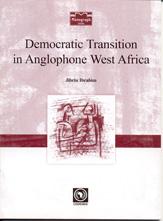
APA Ibrahim, J. (2003). Democratic Transition in Anglophone West Africa. CODESRIA. https://doi.org/10.57054/codesria.pub.287
Chicago Ibrahim, Jibrin. Democratic Transition in Anglophone West Africa. Dakar: CODESRIA, 2003. https://doi.org/10.57054/codesria.pub.287.
MLA Ibrahim, Jibrin. Democratic Transition in Anglophone West Africa. CODESRIA, 2003. https://doi.org/10.57054/codesria.pub.287.
2026
##plugins.themes.clarte.stats.views## : 398
2026
##plugins.themes.clarte.stats.views## : 1 678
2026
##plugins.themes.clarte.stats.views## : 963
2026
##plugins.themes.clarte.stats.views## : 5 650
2025
##plugins.themes.clarte.stats.views## : 4 196
2024
##plugins.themes.clarte.stats.views## : 5 471
2024
##plugins.themes.clarte.stats.views## : 5 464
2024
##plugins.themes.clarte.stats.views## : 6 098 ##plugins.themes.clarte.stats.downloads## : 59
2023
##plugins.themes.clarte.stats.views## : 5 912
2023
##plugins.themes.clarte.stats.views## : 8 262
2023
##plugins.themes.clarte.stats.views## : 2 916 ##plugins.themes.clarte.stats.downloads## : 1 031
2023
##plugins.themes.clarte.stats.views## : 6 888