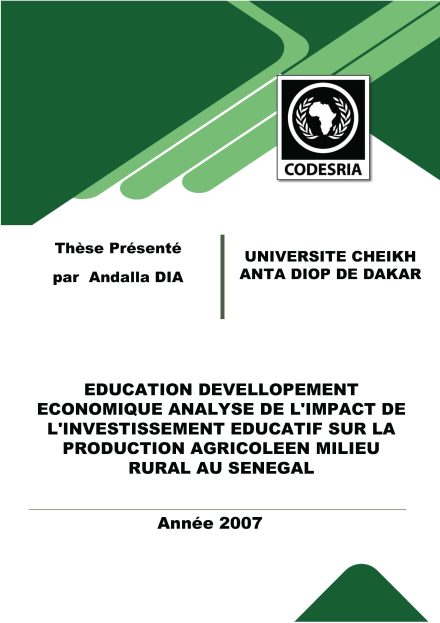
Education et développement économique : analyse de l'impact de l'investissement éducatif sur la productivité agricole en milieu rural au Sénégal
2023
Abstract views : 1,509 Downloads : 222

CODESRIA Books Publication System
Since the Seventies, the vast spreading out of Douala, amplified by a running demography, involved an imbalance of its urban organization. Consequently, disparities increased between the districts, complicating the social and spatial structure and the functioning of the whole area. The construction of the city was and continues to be settled by logics and actions who bring about the amplification of an urban disorder. In this context, the problems which this research approaches are that of the environmental and medical threats related to the bad management of domestic solid waste in Douala, whereas the latter abounds in socio-economic and energy opportunities which could be developed, reducing at the same time ecological hazards. Armed with this knowledge, we introduced the following assumption : « The bad management of domestic solid waste in Douala shows that for the time being it constitutes primarily a threat. The emergence of the popular practices in this management, and the ever-present environmental-medical risks that are related to these practices, testify truly to the existence of the threat. However, since domestic solid waste, beyond the activities of salvage, can also be transformed into “clean manure” or into biomass usable within the framework of renewable energies, we will be able to declare that domestic solid waste is an opportunity in the sustainable development, even if such opportunities are less developed or not in the town of Douala. »
From the observations on the field, the investigations with urban dwellers and some social and institutional actors, the readings in the libraries, the space locations (cartography, ground level and aerial photography), and our empirical knowledge, we can make certain that since the Seventies, the city of Douala undergoes a spectacular space growth. Thus the unconstructible areas (steeply sloping zones, marshes and mangrove) were widely colonized by dwellings, without any plan of preliminary installation. Consequently, the majority of these areas, moreover isolated, which we called territories of middle salubrity and unsanitary territories, hardly provide the effective strategies of modern management. As for the actions implemented by HYSACAM, which is in charge of the modern waste management, they are inadequate. These failures caused the emergence in this management of some popular practices that proved to be unsuitable in the urban milieu, and carrying environmental risks. In addition, economic and energetic opportunities in the field of domestic waste are almost unknown for the majority as well as for the local government.
Therefore we proposed some ways out and ideas about domestic waste which could minimize the threats, while developing related opportunities. Namely : rigorous help observance of the current regulation, installation of a municipal police force of environment, popularization campaigns about the environment and the sustainable development, formal gathering of the NGO that already take part in pre-collection and optimization of refuse, promotion of individual composting, closing of the sole (and harmful) rubbish dump that currently works in Douala, setting-up of a project of biomethanation of waste, and creation of a local ecotax in Cameroon.
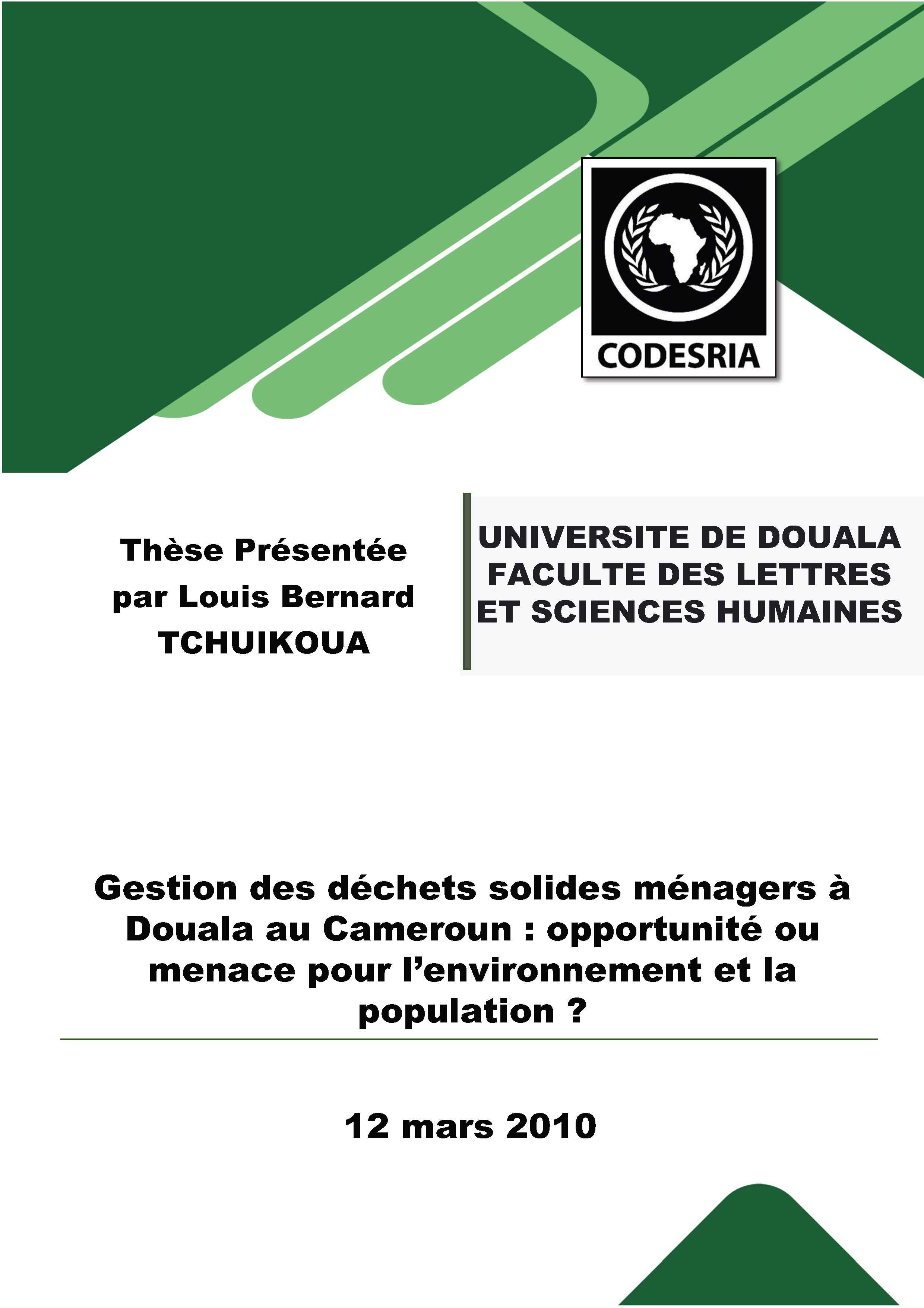
APA TCHUIKOUA, L. B. (2023). Gestion des déchets solides ménagers à Douala au Cameroun : opportunité ou menace pour l’environnement et la population ? CODESRIA. https://doi.org/10.57054/codesria.pub.1601
Chicago TCHUIKOUA, Louis Bernard. Gestion des déchets solides ménagers à Douala au Cameroun : opportunité ou menace pour l’environnement et la population ? Dakar: CODESRIA, 2023. https://doi.org/10.57054/codesria.pub.1601.
MLA TCHUIKOUA, Louis Bernard. Gestion des déchets solides ménagers à Douala au Cameroun : opportunité ou menace pour l’environnement et la population ? CODESRIA, 2023. https://doi.org/10.57054/codesria.pub.1601.
2023
Abstract views : 1,509 Downloads : 222
2023
Abstract views : 1,495 Downloads : 241
2023
Abstract views : 981 Downloads : 184
2023
Abstract views : 990 Downloads : 163
2023
Abstract views : 1,128 Downloads : 163
2023
Abstract views : 993 Downloads : 179
2023
Abstract views : 784
2023
Abstract views : 1,243 Downloads : 189
2023
Abstract views : 787 Downloads : 422
2023
Abstract views : 1,718 Downloads : 253
2023
Abstract views : 704 Downloads : 119