Impacts de l’efficacité Technique sur la Productivité des Exploitations Cotonnières au Burkina Faso
2023
Abstract views : 1,495 Downloads : 241

CODESRIA Books Publication System
The history of man is rife with movements and change of residence within and across territorial boundaries. These involve the detachment from the organization of activities at one place and the movement of the total round of activities to another (Goldscheider, 1971: 64). This phenomenon is termed migration - a process which has been found intricate to be adequately measured. There, also, has always been a reason or reasons for each human move, but the determinants and underlying structures of such are to a large extent complex, and also change over time and space, with far reaching consequences for man and his physical and social environment.
Migration, as one of the three population processes (along with fertility and mortality), is less appreciated but more difficult to assess, though its effects cannot be swept under the carpet. The latter fact prompted Weeks (1992) to assert that whether migration is legal or otherwise, it can profoundly alter a community or an entire country within a short time. The socioeconomic stability and development of any country therefore depend, to an ample degree, on her population composition and the dynamics of population distribution. This lends credence to the study of internal migration, which involves permanent change of residence within national boundaries. With respect to typology, rural to urban migration has been described as the most significant pattern in terms of volume and effects on the sending and receiving areas alike, and has consequently attracted most attention among other patterns of migration (Adepoju, 1986).
It continues to be a major contributor to the rapid growth of cities in the developing world (Todaro and Stilkind, 1981; Oberai and Singh, 1983), and is often blamed for overurbanization and the resultant 'urban decay' and poor quality of life in the rural areas. The rapid urban growth resulting from rural to urban migration has been a demographic issue of concern for governments (Bilsborrow et al, 1984) especially in the third world because of the relationship between spatial distribution of the population and socioeconomic development. Nigeria is not an exception (FGN, 1988; Igbozurike, 1991:16).
This particular study, however, is not intended to revisit the predominant rural-urban migratory pattern, the popular research topic, but to explore the reverse pattern - the urban-rural migration - with reference to its causes, composition and consequences in relation to rural development in the rural communities of Idea to North Local Government Area of Imo state, Nigeria.
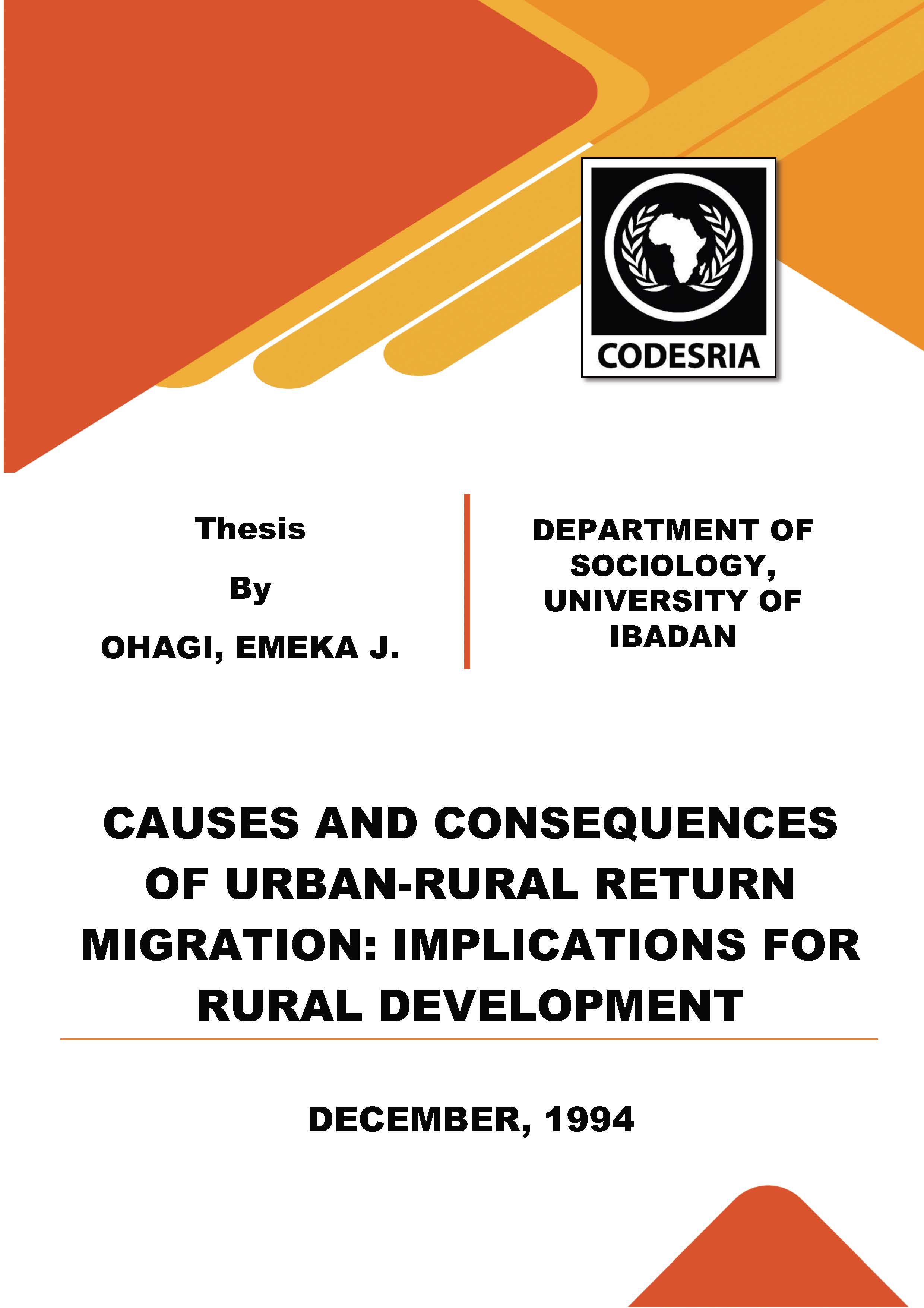
APA J., O. E. (2023). CAUSES AND CONSEQUENCES OF URBAN-RURAL RETURN MIGRATION: IMPLICATIONS FOR RURAL DEVELOPMENT. CODESRIA. https://doi.org/10.57054/codesria.pub.1352
Chicago J., OHAGI, EMEKA. CAUSES AND CONSEQUENCES OF URBAN-RURAL RETURN MIGRATION: IMPLICATIONS FOR RURAL DEVELOPMENT. Dakar: CODESRIA, 2023. https://doi.org/10.57054/codesria.pub.1352.
MLA J., OHAGI, EMEKA. CAUSES AND CONSEQUENCES OF URBAN-RURAL RETURN MIGRATION: IMPLICATIONS FOR RURAL DEVELOPMENT. CODESRIA, 2023. https://doi.org/10.57054/codesria.pub.1352.
2023
Abstract views : 1,495 Downloads : 241
2023
Abstract views : 1,509 Downloads : 222
2023
Abstract views : 993 Downloads : 179
2023
Abstract views : 981 Downloads : 184
2023
Abstract views : 990 Downloads : 163
2023
Abstract views : 1,128 Downloads : 163
2023
Abstract views : 787 Downloads : 422
2023
Abstract views : 1,718 Downloads : 253
2023
Abstract views : 704 Downloads : 119
2023
Abstract views : 784
2023
Abstract views : 1,243 Downloads : 189