Impacts de l’efficacité Technique sur la Productivité des Exploitations Cotonnières au Burkina Faso
2023
Abstract views : 1,495 Downloads : 241

CODESRIA Books Publication System
The thesis deals with the discursive representation of women’s interests and needs in Makueni District, a rural area in the eastern part of Kenya. The study explores the mismatch between the way politicians and other community leaders select and represent these interests and needs and the way women construct these issues in women’s groups. It provides a fresh approach to the study of women’s issues by using a Critical Discourse Analysis (CDA) as a means of uncovering the subtle ways in which the representation of these issues interfaces with questions of power. The thesis explores the overall question: how does a study of the language used to talk about women’s interests and needs help us understand the constraints and possibilities for women with regard to agency and change? Data was collected from political rallies, interviews and focus group discussions. The data for the entire study consists of four political speeches, ten interviews with politicians and other community leaders and eleven focus group discussions with women’s groups. CDA as theory and method provides a framework for understanding how prevailing discourses impact on the participation of women in the political process in Kenya.
A key finding of the research is that though women, politicians and other community leaders construct women’s agency within deficit discourses, these discourses do not match women’s enacted practices or what political and community leaders say they expect of women. The contradiction that emerges from the study is that although everyone constructs women as lacking in agency, these women act as agentive subjects. All these three categories of research participants draw on prevailing discourses about women in Kenya which locate women is a discourse of negative representation. This language reflects and reproduces the exclusion of women in the political process because it is hard for women to believe that they have a contribution to make when they are interpellated by these deficit discourses. Women for example continuously demand for a leader, a mentor and a saviour; an individualized discourse yet agency and sustainability depend on the collective. Further, my research has shown that women’s groups that are the focus of this study (popularly known as merry-go-rounds in Kenya) are not ‘feminist’ groups. While the aim of feminist groups is transformation, the aim of the women’s groups is sustainability.
Overall, the study shows that women’s power is located in traditional discourse and collective action is at the heart of women’s ability to sustain their existence and their communities. Women’s inaction on the other hand is located in deficit discourses, a negative discourse on women. If they were to understand and recognize the power of the collective, and that power is in the collective and not in an individual leader, they might choose to influence the political process in a different way. Such understanding might provide different possibilities for political agency and transformation. The key finding of this research is the need to change the discourse of negative representation so that women can recognize their own potential for power.
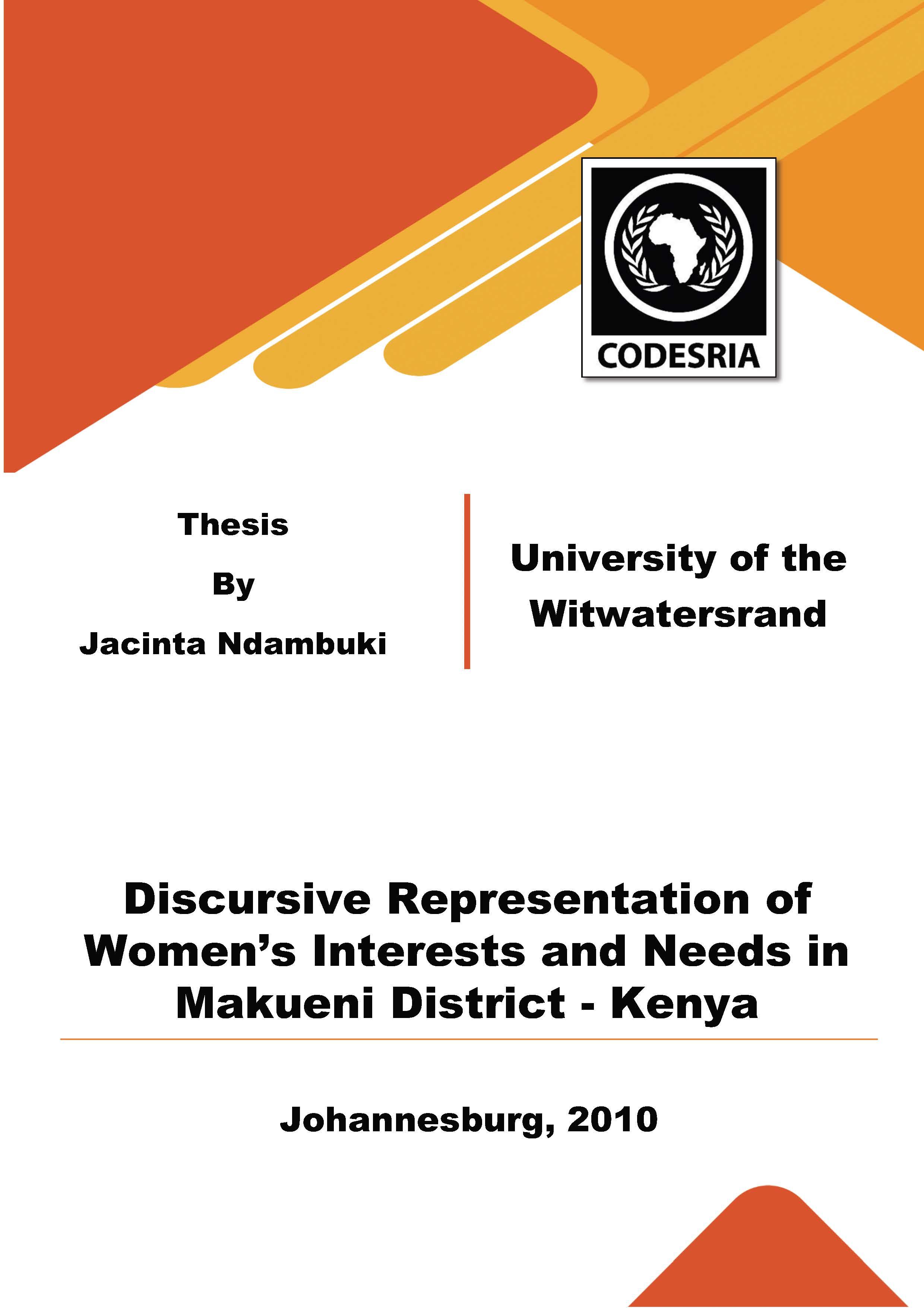
APA Ndambuki, J. (2023). Discursive Representation of Women’s Interests and Needs in Makueni District - Kenya. CODESRIA. https://doi.org/10.57054/codesria.pub.1100
Chicago Ndambuki, Jacinta. Discursive Representation of Women’s Interests and Needs in Makueni District - Kenya. Dakar: CODESRIA, 2023. https://doi.org/10.57054/codesria.pub.1100.
MLA Ndambuki, Jacinta. Discursive Representation of Women’s Interests and Needs in Makueni District - Kenya. CODESRIA, 2023. https://doi.org/10.57054/codesria.pub.1100.
2023
Abstract views : 1,495 Downloads : 241
2023
Abstract views : 1,509 Downloads : 222
2023
Abstract views : 990 Downloads : 163
2023
Abstract views : 1,128 Downloads : 163
2023
Abstract views : 993 Downloads : 179
2023
Abstract views : 981 Downloads : 184
2023
Abstract views : 784
2023
Abstract views : 1,243 Downloads : 189
2023
Abstract views : 787 Downloads : 422
2023
Abstract views : 1,718 Downloads : 253
2023
Abstract views : 704 Downloads : 119