Impacts de l’efficacité Technique sur la Productivité des Exploitations Cotonnières au Burkina Faso
2023
Abstract views : 1,495 Downloads : 241

CODESRIA Books Publication System
In 2007, more than 923 million people did not have enough to eat (FAO, 2008), especially in developing countries. Simultaneously, several forest foods are available but under-utilized. Among them, the baobab tree (Adansonia digitata L.) is a key economic tree, a multipurpose, widely-used species, rich in nutrients in its leaves and fruits, used daily by local populations in several African countries for food, medicines and other purposes. The tree contributes significantly to nutrient supply in those areas where it grows. So far, few studies have been undertaken on the valorization of the species and on its contribution to food security in Africa. The present work focused on indigenous knowledge and nutritional aspects concerning baobab foods, necessary for further valorisation and improvement of local food processing practices. The objectives of the study were to (i) review the nutritional value of baobab parts, (ii) document ethno-food knowledge related to baobab food products in rural areas in Benin, (iii) assess the effect of traditional processing on in vitro digestibility and bioavailability of minerals and carotenoids in sauce made of baobab leaves, (iv) characterise the microbiological flora of baobab fermented food products and (v) build quantitative information on degradation of baobab pulp quality during storage. The review on baobab foods showed that pulp from baobab fruits is particularly rich in vitamin C (150 to 360 mg/100 g dw). The leaves are particularly rich in calcium (307 to 2640 mg/100 g dw). The whole seeds and the kernels have a relatively high lipid content, viz. 12 to 33 g/100 g dw and 19 to 35 g/100 g dw, respectively. The pulp and leaves exhibit antioxidant properties with a higher activity in the pulp than in the leaves. Two hundred and fifty-three processors of baobab food products were surveyed in Benin, to investigate the ethno-food knowledge related to baobab and the variation among socio-cultural groups. Local populations reported up to 35 baobab food products processed from the leaves, the pulp, the seeds and the kernels, most of which have never been characterized. Multivariate analysis showed that the types of foods processed from baobab differed among socio-cultural groups. The survey revealed that seed decortication is considered to be the most laborious processing operation and that the preservation of pulp and kernels is difficult in local conditions. The effect of processing on the quality of traditionally processed baobab leaves was evaluated. Assessment of in vitro digestibility and bioavailability of Ca, Fe, and Zn in non processed and processed baobab leaves showed that 10-30% of total Ca was available and that lutein and beta-carotene are the most important carotenoids. Moreover, “bitter leaves” are richer than “sweet leaves”, though the latter are the preferred ones. However, the experiments on Fe and Zn in vitro digestibility require further attention because of experimental difficulties caused by the sliminess of the leaves.
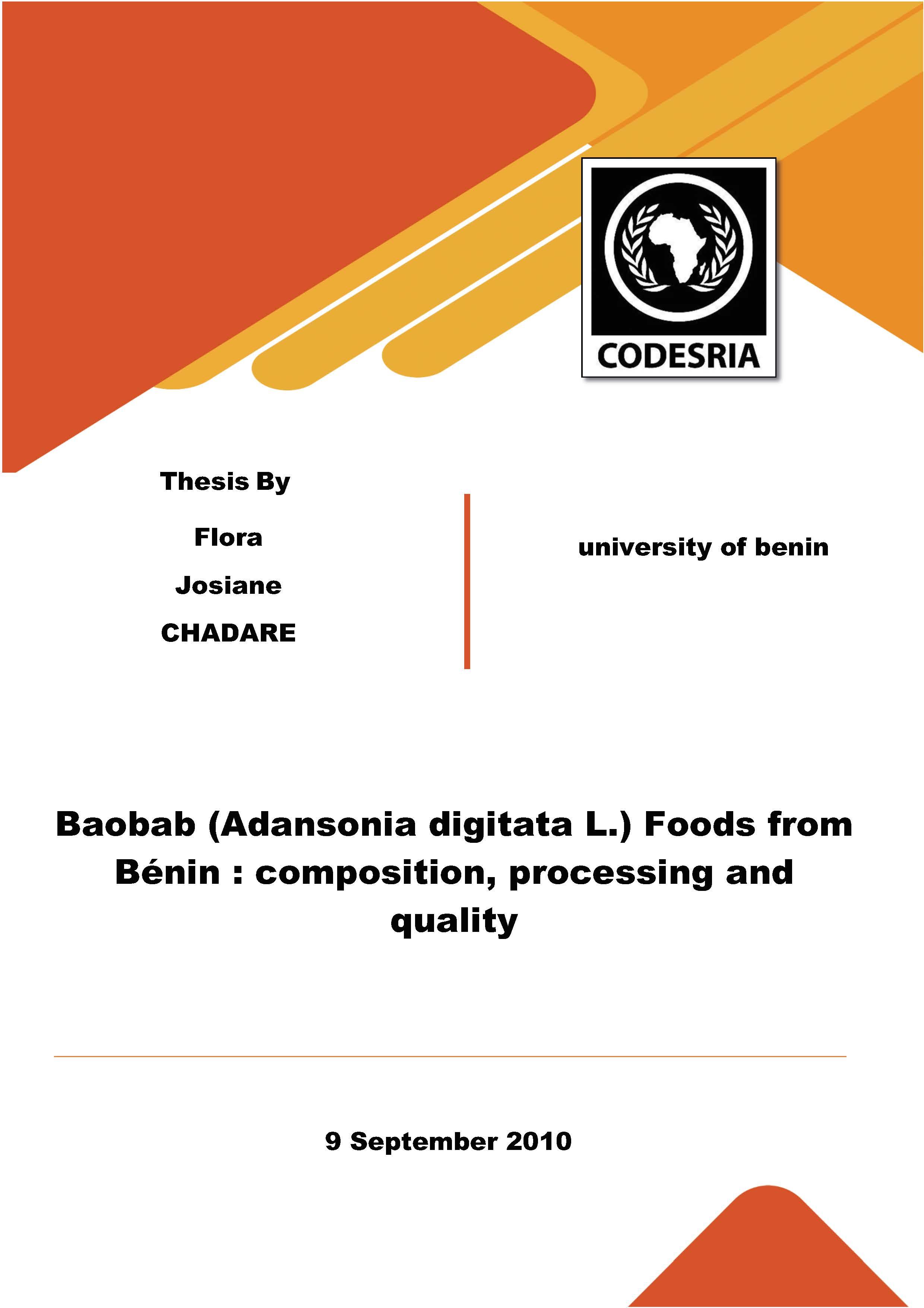
APA CHADARE, F. J. (2023). Baobab (Adansonia digitata L.) Foods from Bénin : composition, processing and quality. CODESRIA. https://doi.org/10.57054/codesria.pub.2142
Chicago CHADARE, Flora Josiane. Baobab (Adansonia digitata L.) Foods from Bénin : composition, processing and quality. Dakar: CODESRIA, 2023. https://doi.org/10.57054/codesria.pub.2142.
MLA CHADARE, Flora Josiane. Baobab (Adansonia digitata L.) Foods from Bénin : composition, processing and quality. CODESRIA, 2023. https://doi.org/10.57054/codesria.pub.2142.
2023
Abstract views : 1,495 Downloads : 241
2023
Abstract views : 1,509 Downloads : 222
2023
Abstract views : 993 Downloads : 179
2023
Abstract views : 981 Downloads : 184
2023
Abstract views : 990 Downloads : 163
2023
Abstract views : 1,128 Downloads : 163
2023
Abstract views : 787 Downloads : 422
2023
Abstract views : 1,718 Downloads : 253
2023
Abstract views : 704 Downloads : 119
2023
Abstract views : 784
2023
Abstract views : 759 Downloads : 135