Education et développement économique : analyse de l'impact de l'investissement éducatif sur la productivité agricole en milieu rural au Sénégal
2023
Abstract views : 1,509 Downloads : 222

CODESRIA Books Publication System
This study examined the linkage between exchange rate variability and currency Substitution in Nigeria. Specifically, the study tested for the existence of currency substitution and attempted to gauge its magnitude in Nigeria. Also, causality between currency substitution and exchange rate volatility in Nigeria was investigated. Subsequently, the study analyzed the implications of currency substitution and exchange rate volatility for monetary policy in Nigeria.
The study covered a period of 17 years -1986(1)-2001(4). Quarterly time series data collected from the International Financial Statistics published by the International Monetary Fund (!MF) and Central Bank's Statistical Bulletin were used for the analysis.
The time series properties of the variables were determined using the Augumented Dickey Fuller (ADF) test and the Phillip-Perron Z-test. The study adopted the unrestricted portfolio balance model of currency substitution, incorporating exchange rate volatility within the framework of the Vector Autoregression (VAR) technique. This was complemented with Autoregressive Conditional Heteroscedasticity (ARCH) model to determine the volatility or otherwise of exchange rate in Nigeria.
The ARCH and Component ARCH model indicated that the sum of the ARCH and GARCH Coefficients was 0.938711 for nominal parallel exchange rate, and 1.0049774 for real parallel exchange rates. These suggested that volatility shocks were quite persistent in both the nominal and real parallel market exchange rates in Nigeria against the U.S. Dollar. The estimate of the persistence of nominal parallel market exchange rate in the long run component was 0.83, indicating that the long run exchange rate volatility component converged very slowly to the steady state. The short-run exchange rate volatility was 0.641034. Also, official exchange rate was volatile in the short run especially in the early stage of liberalization but relatively stable as from 1992.
Also, our econometric exercises revealed the presence of currency substitution in Nigeria. Major factors driving this process were domestic inflation, expected change in the Nigerian Naira/US Dollar exchange rate and real parallel market exchange rate volatility. The coefficient of current level of GDP in the models showed that currency substitution was for store-of- value purposes in Nigeria. Measured in terms of stock, the average currency substitution index for Nigeria was 5.5 percent, indicating that Nigeria could be classified as moderately dollarized economy. The empirical results of Granger causality test support a bi-directional relationship. However, causality from currency substitution to exchange rate volatility appears stronger and dominates Results from both impulse response and the forecast error variance decomposition functions suggest that exchange
rate volatility and currency substitution responds to monetary policy with some lags. Hence, a one-time standard deviation shock to monetary policy variable would tend to dampen exchange rate volatility and currency substitution in the medium horizon but might not be effective in the short horizon.
The study concludes that currency substitution was not an instant reaction to the slightest policy mistake rather; it was fallout from prolonged period of macroeconomic instability. The major sources of this instability in Nigeria were untamed fiscal deficits leading to high domestic inflation, real parallel market exchange rate volatility, speculative business activities of market agents in the foreign exchange rate market and poor/inconsistent or uncertainty in public policies. In terms of policy choice, our result favours exchange rate based monetary policy as against interest based monetary policy for stabilization in dollarized economies.
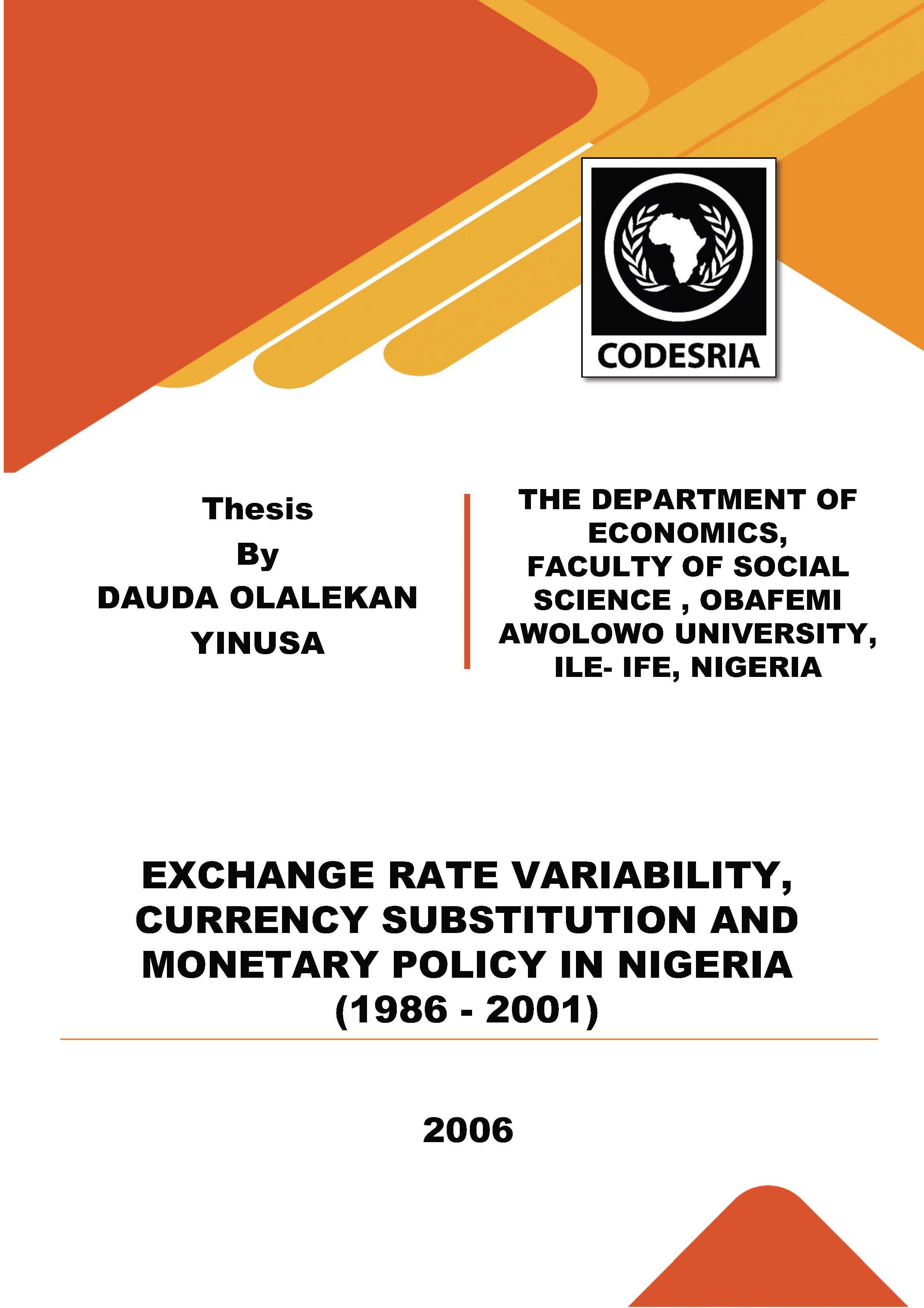
APA YINUSA, D. O. (2023). EXCHANGE RATE VARIABILITY, CURRENCY SUBSTITUTION AND MONETARY POLICY IN NIGERIA (1986 - 2001). CODESRIA. https://doi.org/10.57054/codesria.pub.1830
Chicago YINUSA, DAUDA OLALEKAN. EXCHANGE RATE VARIABILITY, CURRENCY SUBSTITUTION AND MONETARY POLICY IN NIGERIA (1986 - 2001). Dakar: CODESRIA, 2023. https://doi.org/10.57054/codesria.pub.1830.
MLA YINUSA, DAUDA OLALEKAN. EXCHANGE RATE VARIABILITY, CURRENCY SUBSTITUTION AND MONETARY POLICY IN NIGERIA (1986 - 2001). CODESRIA, 2023. https://doi.org/10.57054/codesria.pub.1830.
2023
Abstract views : 1,509 Downloads : 222
2023
Abstract views : 1,495 Downloads : 241
2023
Abstract views : 981 Downloads : 184
2023
Abstract views : 990 Downloads : 163
2023
Abstract views : 1,128 Downloads : 163
2023
Abstract views : 993 Downloads : 179
2023
Abstract views : 704 Downloads : 119
2023
Abstract views : 784
2023
Abstract views : 1,243 Downloads : 189
2023
Abstract views : 787 Downloads : 422
2023
Abstract views : 1,718 Downloads : 253