MARCHES, MARCHANDISES ETMARCHANDS DANS LES ABORDS SUD DU LAC TCHAD : XIXè - XXè SIECLES
2023
Abstract views : 919 Downloads : 318

CODESRIA Books Publication System
This study investigated the role of Uganda’s Electoral Commission in the management of
the 2006 Presidential Elections. The role of electoral bodies in managing national elections
constitutes a central contribution to the democratisation process in any country. Since
elections are a beginning of democratic transition (Bratton and van de Walle, 1997), the
way they are administered affects their outcome and legitimacy of elected officials
(Burnell, 2002; Elklit and Reynolds, 2002). While elections are political processes that
need to be conducted according to the law (Bwengye, 1985; Tumwine-Mukubwa, 2004), an
election involves administrative, managerial and technical processes, whose
accomplishment requires the input of honest, competent, professional and unbiased
officers who emphasize the legal and legitimate provisions in executing their duties.
Beyond procedures and legal provisions, the behaviour and actions of elections
administrators and other stakeholders also affects electoral outcomes. The study
interrogates the place of election management in the democratisation debate using
findings generated through qualitative methodology.
It was discovered that the Electoral Commission did a reasonably commendable job in
election management through improved voters’ register, complaints handling
mechanisms, use of consultative approach to arrive at decisions, and following a consistent
electoral time-table. This was possible because of internal improvements within the
Commission as well as pressures from politicians, donors and the keen civil monitoring.
The Commission was constrained by institutional inability to curb campaign-related
violence, violation of electoral guidelines, incumbency advantages, non-compliance with
electoral laws, financial limitations, de-enfranchisement of voters, delayed electoral laws
and mistrust amongst politicians. Centrally, for the Commission to ensure free and fair
elections, other stakeholders: government institutions, political parties, civil society,
donors, as well as the general public, need to execute their respective constitutional
mandates. It is recommended that the Commission works more closely with other
stakeholders to ensure strict adherence to electoral laws, and reduce the challenges that
have continuously affected election management.
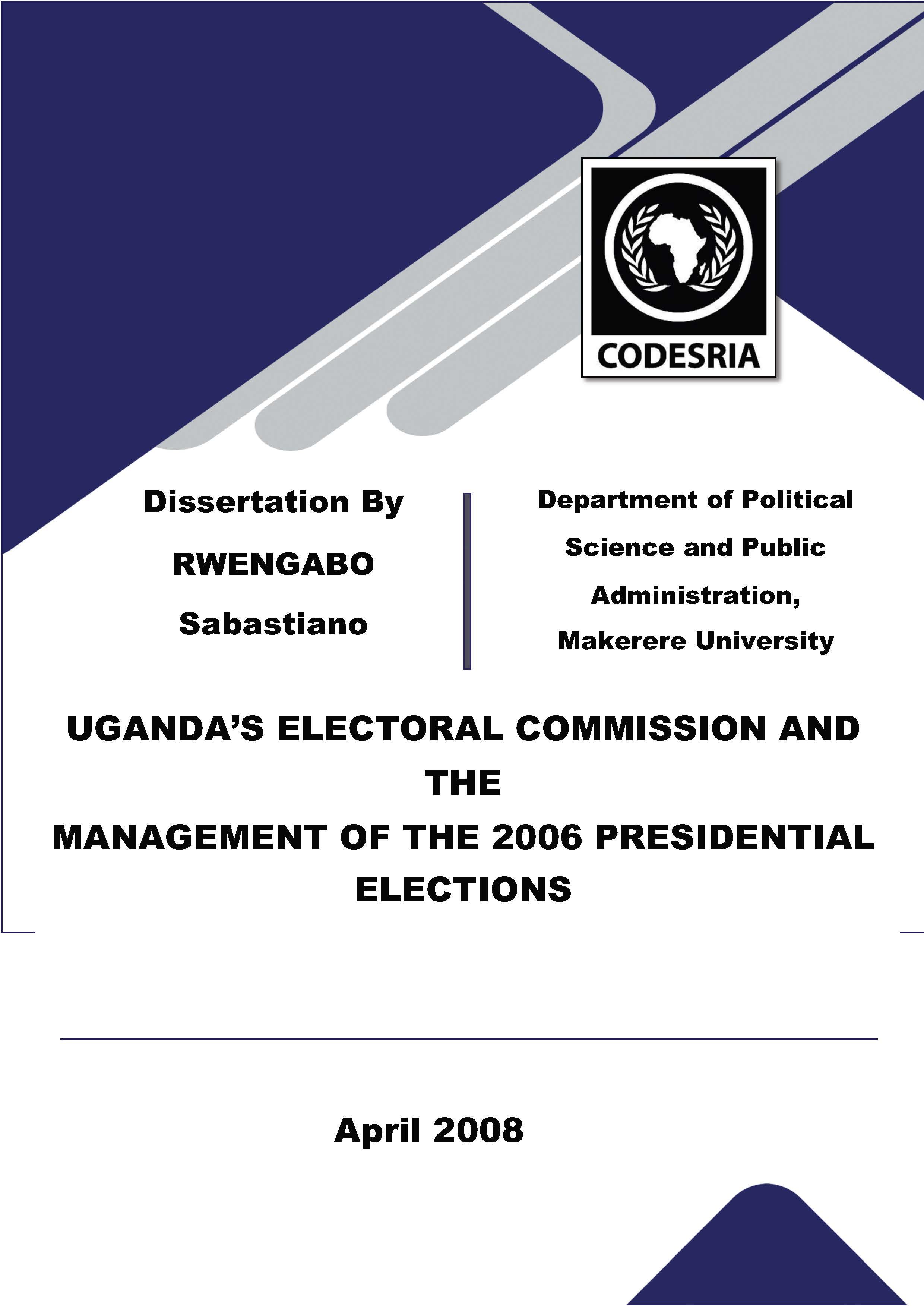
APA Sabastiano, R. (2008). UGANDA’S ELECTORAL COMMISSION AND THE MANAGEMENT OF THE 2006 PRESIDENTIAL ELECTIONS. CODESRIA. https://doi.org/10.57054/codesria.pub.1343
Chicago Sabastiano, RWENGABO. UGANDA’S ELECTORAL COMMISSION AND THE MANAGEMENT OF THE 2006 PRESIDENTIAL ELECTIONS. Dakar: CODESRIA, 2008. https://doi.org/10.57054/codesria.pub.1343.
MLA Sabastiano, RWENGABO. UGANDA’S ELECTORAL COMMISSION AND THE MANAGEMENT OF THE 2006 PRESIDENTIAL ELECTIONS. CODESRIA, 2008. https://doi.org/10.57054/codesria.pub.1343.
2023
Abstract views : 919 Downloads : 318
2023
Abstract views : 977 Downloads : 265
2023
Abstract views : 1,128 Downloads : 196
2023
Abstract views : 992 Downloads : 215
2023
Abstract views : 1,224 Downloads : 159
2023
Abstract views : 1,129 Downloads : 248
2023
Abstract views : 1,188 Downloads : 195
2023
Abstract views : 936 Downloads : 227
2023
Abstract views : 1,091 Downloads : 203
2023
Abstract views : 1,113 Downloads : 118
2023
Abstract views : 991 Downloads : 164
2023
Abstract views : 870